Creating measurable change in the field

The Responsible Mica Initiative (RMI) drives measurable, long-term improvements across mica-extracting regions by transforming supply chains, strengthening governance, and empowering mining communities. Our impact is rooted in collaborative action and supported by a clear, evidence-based strategy designed to deliver lasting change.

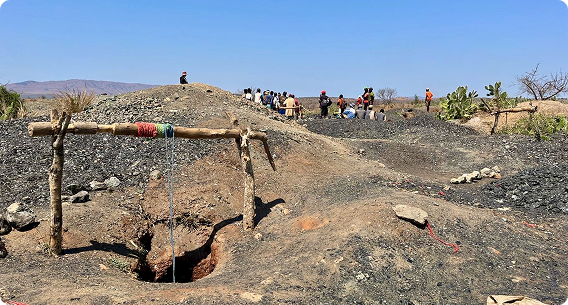
Pile of mica on a tarp at a sorting site in Madagascar

Using our theory of change to connect actions to real-world impact 

RMI’s impact is guided by a comprehensive Theory of Change, which links our activities to short-, mid-, and long-term results. This framework ensures that each intervention – whether related to workplace standards, community programs, or advocacy efforts – contributes to meaningful and durable improvements.

By clarifying causal pathways and identifying conditions needed for success, the Theory of Change strengthens program design, highlights where support is most needed and provides the foundation for consistent monitoring and evaluation.

Key data and achievements

0

Villages
Representing: 114,061 beneficiaries and 50,725 children

0

processors engaged (membership, audits, training…)

0 +

training sessions provided to Indian & Malagasy processors 

0

external audits conducted

Focus on Community Empowerment Program’s impact

RMI’s Community Empowerment Programs (CEP) delivers concrete benefits that improve daily life in mining communities. These programs address the social and economic factors that drive vulnerability and help create a safer, more resilient environment for children and adults alike.

  • RMI supported 230 villages, for a global outreach of 111,984 beneficiaries (or 21,954 households), including 49,472 children.
  • 2,719 children newly enrolled in school or educational facilities, including 998 in Balwadi centers (early childhood education)
  • 1,700 scholarships provided
  • 59 safe-drinking water units installed, benefitting 4,433 households
  • 117 health camps organized, benefitting 16,117 persons
  • 169 nutrition camps organized, benefitting 3,907 persons
  • 1,281 malnourished children successfully treated
  • xxx k€ invested on Community Empowerment Programs 
  • Programs initiated in 5 villages, representing 2,077 beneficiaries
  • 855 children newly enrolled in school or educ. facilities
  • 4 schools built by end 2025
  • 7-month literacy sessions benefitting 314 adults
  • 4 safe-drinking water units installed by end 2025, benefitting 2,077 households
  • 6 one-week sessions on child labor prevention 

Transforming mica supply chains through transparency

RMI members commit to the principle of supply chain transparency, recognizing that responsible sourcing begins with traceability of supply chain actors. Every member commits to support upstream actors – including mines, artisanal mining groups, and processing units – to adopt responsible workplace standards and progress towards safer, and more responsible labor practices.

Focus on our standards’ impact

The Global Workplace Standard for Mica Processors in numbers: 

  • 5 verticals: Governance, Occupational Health & Safety (OHS), Social, Environment, Supply Chain Due Diligence
  • 420 criteria
  • 14 auditors in 3 auditing agencies trained, including 11 for India and 3 for Madagascar 
  • 25 audits overall from 2022 to 2024
  • XX audits conducted in India and XX in Madagascar 

Comparison of processing site average compliance scores: 

  • 1st time audit: 64.5%
  • 2nd time audit: 79.22% 

Average overall compliance rate of 86% among RMI members after 2nd time audits 

There is insufficient historical data to enable us to draw conclusions.

NB: the Mica CRAFT Code is still in the implementation support phase, so the RMI has not yet begun its audits, hence the lack of compliance figures.  

The Mica CRAFT Code in numbers, implemented in Madagascar only:  

  • Trainings launched in 2024 at 6 mining sites 
  • 15 Occupational Health & Safety training sessions provided
  • 3 successful mining permits applications filed on behalf of mining groups
  • 300 personal protective equipment distributed
  • 180 mining equipment distributed
  • 56 miners trained 

NB: the Mica CRAFT Code is still in the implementation support phase, so the RMI has not yet begun its audits, hence the lack of compliance figures.  

Field-level results in key mica regions

Initiating change in India and Madagascar

RMI's programs generate direct, measurable impact in mica-producing areas of India and Madagascar, where poverty, informal mining, and limited access to services heighten risks for workers and children.

Legal Frameworks

RMI’s Approach

RMI works with civil society organizations, local businesses, government agencies, and sector experts to promote clear, enforceable legal frameworks that protects workers, prohibits child labor, and enables responsible mica extraction in its programmatic focus countries.